Showing posts with label situated objects. Show all posts

Wednesday, 1 April 2015

A Kickstarter Start


A Kickstarter Start
I shall be launching a ‘Kickstarter’ crowd-funding campaign soon. I aim to have the first draft of my book, ‘Walk with me! - Connecting People to Place’ (working title) written by the time the swallows return. This normally coincides with my sister in laws birthday on the 8th of May.

The path torwards the beach on Seasalter levels.

Last year I saw lots of swallows fly in when I was on the phone to a friend who travels a lot in India and fondly watches them fly in and out of her window in the majestic fort in Jodhpur where she works. It was a coming home for me to see them back again and perhaps a reminder of a more exotic place for her.

 
Beach huts overlooking the sea.
I am giving myself a full month to come up with the first draft of the book. Most of the content is already written within this blog and in my research papers. So I am now in the process of analysing the content and themes, looking for a thread that will run through the work and getting in contact with and creating a team of experienced, inspirational and capable people to make this happen.

Looking east towards Whitstable.

Birds on the shore and bait diggers in the background.

I want the book to be beautiful in every way, this includes the illustrations and layout of the text, but it also involves deciding on the font, the typographic form and layout, proportion, paper weight, finish and final format.
Phew! And if that is not enough, to create a successful ‘Kickstarter’ project, the campaign itself needs to be carefully and professionally run, in time, achieving the full amount of funding asked for, otherwise nothing is received. This makes it an ideal platform for investors to use, they cannot lose; the project will only go ahead and use their money if full funding is procured.

Rewards
A main aspect of most crowd-funding campaigns is the rewards offered. These vary widely; they could be personal thanks from the campaign host, such as a tweet, postcard or mention in the book, to a specific invite to an event, a personalised product or in reality, a million other types of reward for their investment.

Random alignment.

It is worth looking at the projects on ‘Kickstarter’, many of them are great ideas, which once a market or audience is proven using this funding platform, then other investors and funding organisations will ‘want in’. I want to provide about five rewards, they will start at £15 and will be for specific experiences and a copy of the book. I will need to make these really desirable and unique.

Detail of driftwood 'seat'.

I wonder whether this basic need for reward comes from our hunter/gatherer roots. It would make sense, to be encouraged to go and join in the harvest, for example, if we were allowed to graze on the food as we picked it. It fact this is often the reward that encourages a family visit to a ‘pick-your-own’ strawberry field!.

Memory Sketches
I thought I would try out a new way, for me, to experience a familiar walk this week. I recorded aspects of a lovely windswept walk at Seasalter with written ‘memory sketches’ and I asked a friend to come with me and we had our reward of lunch at the nearest cafĂ©. The idea of writing as ‘memory sketches’ was a realisation after attending the writing walk with Victoria Field, last week.
Whilst walking mindfully through the wood, we stopped regularly to write.

‘I realised then that this is very similar to sketching a place. When I sketch, I look with more depth into the subject, I capture far more of that moment than when I take a photograph. I suppose this is being mindful, both writing and sketching something specific allows for a deeper observation of the subject.’

Seasalter looking west towards the Swale.

When I attended her follow on writing workshop later that week I realised that this observation and writing pattern was something that could be practiced in a group quite readily. Initially, I was quite nervous to share my ‘sketchy’ written work, but as I and others did there was a real sense of creative spirit which was encouraging and fruitful. I didn’t know what to expect but I really enjoyed the experience and will certainly love to do it again.

Looking out at numerous man-made reminders, worn and familiar.

One of the poems that were read out was called ‘Vertical’ by Linda Pastan, it related the idea of verticality to us and introduced us to the theme of the workshop, the Blean environment with its static rooted trees and the flowing movement of birds; over, under and through them.

Landmarks
We then were encouraged to write, using an adjective or observation about our awareness of trees. I used my own knowledge of using them as landmarks to create a longer poem from them, this is just a piece.

‘Landmarks’
Trees denote boundaries,
They mark a specific place and many memories are tethered to them,
Our own and others.

In this day of urban sprawl,
Other verticals replace the tree,
Way-marking posts point to destinations impersonating trees but dead, void of breath, growth and habitat.

These verticals do not evoke memories,
But are merely navigational landmarks,
Polished posts act as metal trunks and metal fingers point the way, away from here.

When I taught my walking workshop a couple of days ago I referred again to the primal need humans have for situated objects in a landscape. These act as markers for many aspects of human culture, which include navigation, territorial boundaries or sacred sites.

Situated objects on Seasalter beach.

A phrase I discovered during my MA was ‘persistent places’. These are places that people feel drawn to and return to regularly. There are many ancient sites across the world, such as the Avebury henge complex in Wiltshire, UK that have attracted humans to gather there for thousands of years, build monuments and celebrate the spirit of the place.

Monolithic type structures.

As I took yet more photographs of the man-made wind and sea weathered groynes at Seasalter beach last week, I realised that these too are situated objects and Seasalter is for me a ‘persistent place’.

 
Beach-combing.

Toddler Chic
‘Toddler Chic she calls it,
A red plaid coat, spotty tights and a red beret,
Pom-pommed scarf wrapped tightly around her neck to keep snug in this icy wind,
Looking down for shells, she stoops and picks up beauteous things,
Discovering forms and colours unusual and rare,
Crunching back towards me on the shell shingle she walks,
Ready to go back now,
Towards lunchtime and our reward of lamb-bacon and cake!’

Toddler Chic.

Friday, 28 November 2014

Encounters


Encounters
Situated objects and how we encounter them is a real interest of mine.
This is how I became interested in Spatial Design. I have written about this before in my blog, see ‘The Space between Things’.
I wrote that ‘Design is a powerful process that can be used to influence how people feel in a space. An example of this in its very basic form is to imagine a room, quite bare but at its centre on the floor lays a brown standard hard brick. Now, imagine how this would compare with the same room, again quite bare except in the centre there is a beautiful vase of colourful flowers. Each encounter would feel very different.’
Jan's colourful, busy and warm kitchen was a delight. Nothing contrived about this space.

Watching BBC 2’s ‘The Great Interior Design Challenge’ makes me squirm, I find it compelling but also very formulaic. I guess to make it appeal as entertainment, some drama must be injected into the show, but the ‘good cop/bad cop’ ‘experts’ leave me struggling to comprehend their understanding of design. In the last series they coined such phrases as ‘colour pop’, this time they are mentioning ‘colour winks’. Sigh. Still, I quite like to watch the more professional Tom Dyckhoff struggle with getting his architectural history links into the script. Maybe I am being overly critical of a show that I will want to watch the final of this evening, but it is interesting to see how the contestants contrive groupings of objects within a room’s interior decorating scheme.
So, to recognise real peoples’ choice through their small collections of objects within a space is fascinating, a true insight into their own personal interests, values and expression.
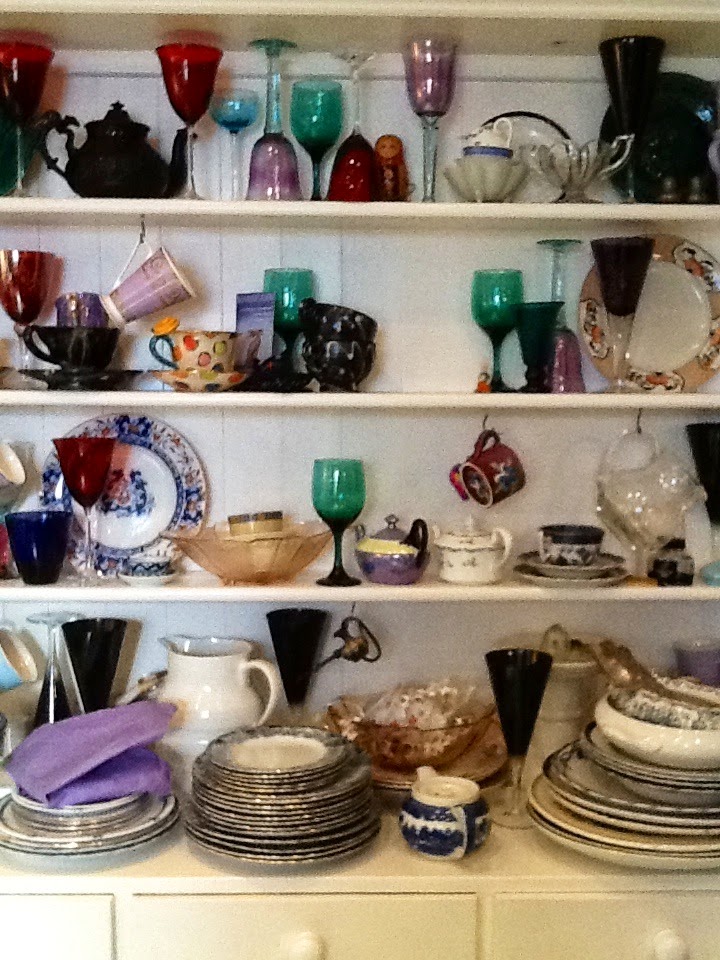
My dresser, with Mark Hearld's book open on it.

Since I wrote an entry in this blog, back in September titled ‘Collections’, I have received a few photos of other peoples dressers. 
Becky's shelves showing my card (middle shelf, off centre.)

Interestingly, one of these had a card on it, that I had made, which had a photograph of my dresser on it. It felt like looking at a form of creative infinity. Another one which was sent to me was of my blog showing the same image on an Ipad, propped up amongst someone else’s personal collection of objects.
My windowsill, another favorite place for collections.

These objects often have such importance to the owner that when gathered together they almost have the reverent feel of an altar. I remember the nature table at school, this to me had a similar feel.
A nature table as illustrated in my 'Going to School' Ladybird book of 1959.

It was a very powerful reminder of the season that we were in and the importance and beauty of natural forms.

Yes, what is it about kitchen dressers?
I am currently reading ‘Toast and Marmalade and other stories’, by Emma Bridgewater.
A kitchen dresser spread from Emma Bridgewater's book, 'Toast and Marmalade'.

As much as I suspected that I would find her writing annoying, perhaps a bit too middle class, I will admit to loving the book.
She has a chapter called, ‘Little altars everywhere’ and ‘What is it about kitchen dressers?’ She writes, ‘It seems as if these shelf arrangements really are like little altars to creative inspiration, whose regular contemplation is a fundamental part of making design.’
My fairly tasteless but lovely collection of ceramic birds.

Yes, I totally agree, as would Mark Hearld, the artist I also wrote about in September, whose abundantly creative and inspirational finds were pictured grouped together on many shelves.
One of my mantlepieces evoking an altar like quality in the limited space available.

Emma Bridgewater starts off her chapter on dressers by realising that she is more aware of everything on her dresser than she is of the contents of her wardrobe and goes on to write. ‘I think mum was using the dresser in the kitchen in Oxford as a giant collage illustrating family life. She declared on her dresser that matching sets were redundant, that you should follow your heart and that if you did, you would make harmony out of dissonance.’
The shop display dresser at 'Number Seven', Dulverton. A gem of a shop.

When we visited friends last weekend I made sure to take some photos of their dresser for use in this blog. They run ‘Number Seven’, in Dulverton, Somerset. It has to be the most exquisite and beautiful shop that I visit regularly. I love to visit so that I can spend time in there just taking in all the precious handcrafted work. This time, it felt very hard to share the space with others, as it was busy with Xmas shoppers.
Jan's dresser in the kitchen at the back of the shop.

I withdrew from the shop space into the back kitchen when it became busy and sat in the back kitchen by the log burner, drinking tea with friends until it was clear again. Here I photographed Jan’s kitchen dresser and a section of the mantelpiece above the fire.
Jan's mantlepiece over her cosy log burner.

Davina uses a large kitchen dresser in the shop as a display area too, so I was quite happy snapping these photos of other dressers, intrigued by their displays of both personal and retail artefacts. 
'Number Seven' dresser before its festive treatment, it will be even more magical this weekend.


Landscape Collections
Collections of objects in the landscape are curious forms. I am thinking of situated objects such as stones that form Stonehenge or any other stone circle. Groupings of worked timber pieces are also curious as they often have or have had a purpose.
 
Timber forms in the landscape. Looking across to Wales.
They are a reminder that we, as humans, have been able to adapt and repurpose natural resources to create solutions for many of our needs, including sacred, industrial and domestic use.
Sea worn and wind weathered timber remnants.

Over the weekend as we walked on Blue Anchor beach after a hearty breakfast at The Driftwood CafĂ©, I saw in the distance rows of timber posts. They were well worn and not in a rhythmic organised style that I recognised from the sea defences along the Kent coast, which are called ‘groynes.’
Beautifully sculptural timber.

We walked towards them; it seems to be a natural thing to do on a walk, to be drawn to objects in the landscape, especially collections. I wonder if this goes back to our basic instincts, to draw closer to other forms, so that we are less conspicuous, or maybe we are just naturally curious.
The timbers formed a long procession across the beach.

As we drew closer, I encountered a sculptural array of weathered forms. They were apparently the remains of very old fish-traps. I have seen medieval examples on Tankerton Beach, before the new sea defence work piled loads of shingle on top of them. There are some good examples, still on show to the west of Seasalter beach, but these wooden remains were approachable as the tide was out.
 
Another close up showing the smooth tide of time.
They seemed bigger and more impressive on such a wild and windy day and comforting even, to think of others out there in the past, creating and using these traps.

I shall see over the next week whilst walking, whether there is a comfort in finding man made structures in the landscape. They can be seen as landmarks and points to navigate by, but maybe by their very existence there is a reassurance in their human connection, especially in wild landscapes.


(I completed my MA in September 2014 and recorded the last two months of it in another blog called www.thesaltwayfarer.blogspot.co.uk
Please feel free to look at that anytime, as it is from that, that I am where I am now.)

Monday, 10 November 2014

Recognition


Recognition
I believe that humans need to feel like they have a purpose in the world. When this is recognised, a feeling of value is generated. This feeling of value creates happiness which in turn can encourage good health and wellbeing. So, to go to a ‘conversation’ about value and come out of it 3 hours later none the wiser left me disheartened and frustrated. The ‘Creative Challenge’ hinted at, but not explained by the host, Uwe Derkson, on the day was ‘How Do We Articulate Value?’  
His co-host was Nixiwaka Yawanawa, a member of the most endangered tribe in the world, the Awa, who has been working with Survival International since 2013.
I really enjoyed hearing Nixiwaka talk. It felt a privilege to be there and hear his considered answers to all the questions that he was asked. He explained that his tribe all have a calling to connect with the land, they live in nature and practice spirituality regularly, through ritual, ceremonies and journeying. Two shamans guide them, one is 102 years old and the other one, well, he explained, no-one really knows how old he is…
I will not explain any more about the ‘conversation’, as I was deeply ashamed to have been part of UCA, (the University of the Creative Arts), in the not too distant past. I completed my MA with them just over a year ago and it was with a form of loyalty that I chose my old college, (Medway College of Design), which now forms part of the UCA, as a base for my learning. To cut a long and disturbing story short, I felt it was nothing but aloofness and arrogance that Uwe Derkson represented on that day, on behalf of the UCA, to both the audience, me included and to Nixiwaka.
When I spoke to Nixiwaka after the event it transpires that he does not judge, he and his tribe share and he recognises his purpose whilst over here is to educate others about the threatened indigenous peoples’ way of life. I really hope to catch up with him another time, I would love to walk with him in nature and understand more about his tribes’ connection with the land.
I had identified this quote earlier in the week for this blog and now it seems even more meaningful. If more of us were able to connect with the spirit of nature and access the wisdom of our ancestors, we would take more care of the miracle which is life.

"The more clearly we can focus our attention on the wonders and realities of the universe around us, the less taste we shall have for destruction" - Rachel Carson

Connecting People
So, I wonder, how can this be done? I think, by just getting out there and walking.

Walking and experiencing reality.
Both, in nature and in urban areas,
Along paths, across landscapes.
Walking.
Placing one foot in front of another.
Pacing, breathing and being.
Becoming human again. 

Peace can be found in this way.

Walking.
People to place
Connecting people
Putting peace in place.


Movement
I remember at school, in Biology, learning a mnemonic for a living thing. The word was REMRING. It featured all the factors needed for life. I still remember it today. Respiration, excretion, movement, reproduction, ingestion, nutrition and growth.  Movement is the factor I recognised the other day which was key to my walking project. Ok, it’s obvious now, so it seems a bit silly to have pointed it out, but if I am going to take anything from meeting Nixiwaka, it is a keenness to not judge (as often) and to share (more). The most exciting quote I could relate to whilst writing my MA critical paper was by Francesco Careri. It was about how, as humans we stood up and walked and what it meant to us in the world.

‘…walking takes on a symbolic form that has enabled man to dwell in the world. By modifying the sense of the space crossed, walking becomes man’s first aesthetic act, penetrating the territories of chaos, constructing an order on which to develop the architecture of situated objects. Walking is an art from whose loins spring the menhir, sculpture, architecture, landscape. This simple action has given rise to the most important relationships man has established with the land, the territory.’ Page 20. careri. F. (2009) Walkscapes GG:Spain

Realising that this was the key factor to my project I recognised why Arlette George and I had been introduced. She is a trained dancer and choreographer. Her mastery of movement using the human form will be crucial to us understanding the importance of getting people out there walking. Because using our body as an instrument to sense and experience the world and connect with nature is something that we may have to relearn. To reclaim our territory and to rediscover our sense of place in the communities, in which we live, will require getting out and walking amongst them. In exploring movement as dance and not just walking, I came across this website.

'The Planetary Dance is an annual all-day ritual of healing and community renewal. It brings people of all ages and abilities together in a beautiful setting to dance for a purpose.'

I see the land as needing us to appreciate it, to wonder at all of its resources and recognise our place within it. We are hugely lucky to be living at this time in this place. I believe we need to walk on the land and see its beauty and in connecting to nature in this way, we become part of its system again. The paths can be seen as a metaphor for the future health of the planet and ourselves. Our vascular and respiratory system will improve as we walk more regularly and the flow of people out in nature will allow a deeper understanding of our land.
Then I truly hope we can find our

'Peace in Place'.

(I completed my MA in September 2014 and recorded the last two months of it in another blog called www.thesaltwayfarer.blogspot.co.uk
Please feel free to look at that anytime, as it is from that, that I am where I am now.)