
Encounters
Situated
objects and how we encounter them is a real interest of mine.
This
is how I became interested in Spatial Design. I have written about this before
in my blog, see ‘The Space between Things’.
I
wrote that ‘Design is a powerful process that can
be used to influence how people feel in a space. An example of this in its very
basic form is to imagine a room, quite bare but at its centre on the floor lays
a brown standard hard brick. Now, imagine how this would compare with the same
room, again quite bare except in the centre there is a beautiful vase of
colourful flowers. Each encounter would feel very different.’
 |
| Jan's colourful, busy and warm kitchen was a delight. Nothing contrived about this space. |
Watching BBC 2’s ‘The Great
Interior Design Challenge’ makes me squirm, I find it compelling but also very
formulaic. I guess to make it appeal as entertainment, some drama must be
injected into the show, but the ‘good cop/bad cop’ ‘experts’ leave me
struggling to comprehend their understanding of design. In the last series they
coined such phrases as ‘colour pop’, this time they are mentioning ‘colour
winks’. Sigh. Still, I quite like to watch the more professional Tom Dyckhoff
struggle with getting his architectural history links into the script. Maybe I
am being overly critical of a show that I will want to watch the final of this
evening, but it is interesting to see how the contestants contrive groupings of
objects within a room’s interior decorating scheme.
So, to recognise real
peoples’ choice through their small collections of objects within a space is fascinating,
a true insight into their own personal interests, values and expression.
 |
| My dresser, with Mark Hearld's book open on it. |
Since I wrote an entry in
this blog, back in September titled ‘Collections’, I have received a few photos
of other peoples dressers.
 |
| Becky's shelves showing my card (middle shelf, off centre.) |
Interestingly, one of these
had a card on it, that I had made, which had a photograph of my dresser on it.
It felt like looking at a form of creative infinity. Another one which was sent
to me was of my blog showing the same image on an Ipad, propped up amongst
someone else’s personal collection of objects.
 |
| My windowsill, another favorite place for collections. |
These objects often have
such importance to the owner that when gathered together they almost have the
reverent feel of an altar. I remember the nature table at school, this to me
had a similar feel.
 |
| A nature table as illustrated in my 'Going to School' Ladybird book of 1959. |
It was a very powerful reminder of the season that we were
in and the importance and beauty of natural forms.
Yes, what is it about kitchen dressers?
I am currently reading
‘Toast and Marmalade and other stories’, by Emma Bridgewater.
 |
| A kitchen dresser spread from Emma Bridgewater's book, 'Toast and Marmalade'. |
As much as I
suspected that I would find her writing annoying, perhaps a bit too middle
class, I will admit to loving the book.
She has a chapter called, ‘Little
altars everywhere’ and ‘What is it about kitchen dressers?’ She writes, ‘It seems as if these shelf arrangements
really are like little altars to creative inspiration, whose regular
contemplation is a fundamental part of making design.’
 |
| My fairly tasteless but lovely collection of ceramic birds. |
Yes, I totally
agree, as would Mark Hearld, the artist I also wrote about in September, whose abundantly
creative and inspirational finds were pictured grouped together on many
shelves.
 |
| One of my mantlepieces evoking an altar like quality in the limited space available. |
Emma Bridgewater starts off
her chapter on dressers by realising that she is more aware of everything on
her dresser than she is of the contents of her wardrobe and goes on to write. ‘I think mum was using the dresser in the
kitchen in Oxford
as a giant collage illustrating family life. She declared on her dresser that
matching sets were redundant, that you should follow your heart and that if you
did, you would make harmony out of dissonance.’
 |
| The shop display dresser at 'Number Seven', Dulverton. A gem of a shop. |
When we visited friends last
weekend I made sure to take some photos of their dresser for use in this blog.
They run ‘Number Seven’, in Dulverton, Somerset.
It has to be the most exquisite and beautiful shop that I visit regularly. I love
to visit so that I can spend time in there just taking in all the precious
handcrafted work. This time, it felt very hard to share the space with others,
as it was busy with Xmas shoppers.
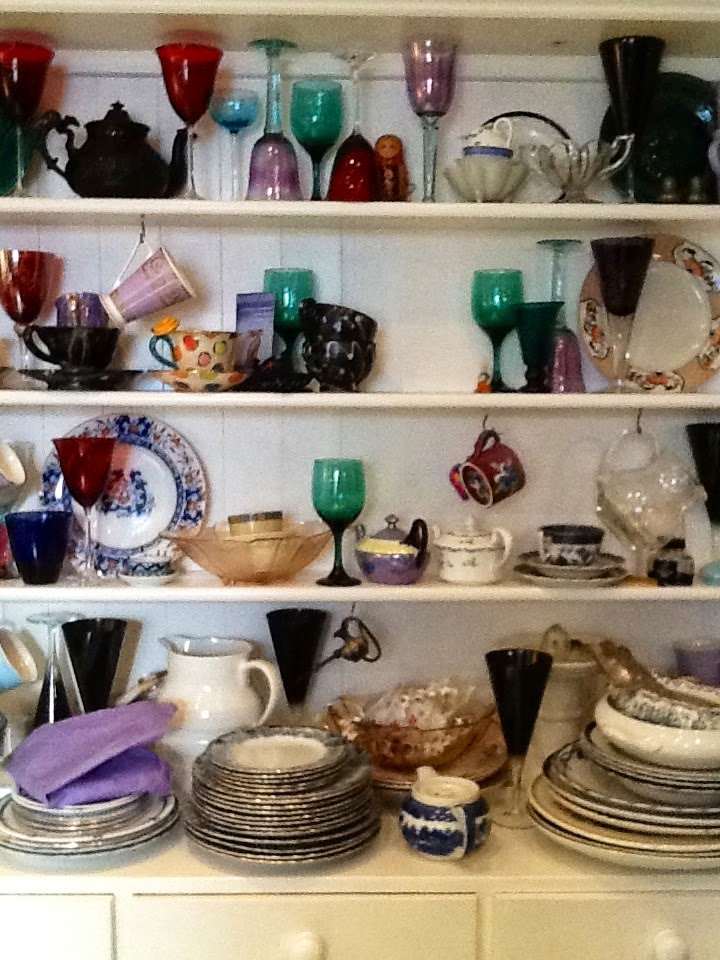 |
| Jan's dresser in the kitchen at the back of the shop. |
I withdrew from the shop space into the back
kitchen when it became busy and sat in the back kitchen by the log burner,
drinking tea with friends until it was clear again. Here I photographed Jan’s
kitchen dresser and a section of the mantelpiece above the fire.
 |
| Jan's mantlepiece over her cosy log burner. |
Davina uses a large kitchen dresser in the shop as a display area too, so I was quite happy
snapping these photos of other dressers, intrigued by their displays of both
personal and retail artefacts.
 |
| 'Number Seven' dresser before its festive treatment, it will be even more magical this weekend. |
Landscape Collections
Collections of objects in
the landscape are curious forms. I am thinking of situated objects such as
stones that form Stonehenge or any other stone
circle. Groupings of worked timber pieces are also curious as they often have
or have had a purpose.
 |
| Timber forms in the landscape. Looking across to Wales. |
They are a reminder that we, as humans, have been able
to adapt and repurpose natural resources to create solutions for many of our
needs, including sacred, industrial and domestic use.
 |
| Sea worn and wind weathered timber remnants. |
Over the weekend as we
walked on Blue Anchor beach after a hearty breakfast at The Driftwood Café, I
saw in the distance rows of timber posts. They were well worn and not in a
rhythmic organised style that I recognised from the sea defences along the Kent coast,
which are called ‘groynes.’
 |
| Beautifully sculptural timber. |
We walked towards them; it seems to be a natural
thing to do on a walk, to be drawn to objects in the landscape, especially
collections. I wonder if this goes back to our basic instincts, to draw closer
to other forms, so that we are less conspicuous, or maybe we are just naturally
curious.
 |
| The timbers formed a long procession across the beach. |
As we drew closer, I encountered a sculptural array of weathered
forms. They were apparently the remains of very old fish-traps. I have seen
medieval examples on Tankerton
Beach, before the new sea
defence work piled loads of shingle on top of them. There are some good
examples, still on show to the west of Seasalter beach, but these wooden
remains were approachable as the tide was out.
 |
| Another close up showing the smooth tide of time. |
They seemed bigger and more
impressive on such a wild and windy day and comforting even, to think of others
out there in the past, creating and using these traps.
I shall see over the next
week whilst walking, whether there is a comfort in finding man made structures
in the landscape. They can be seen as landmarks and points to navigate by, but
maybe by their very existence there is a reassurance in their human connection,
especially in wild landscapes.
(I completed my MA in September
2014 and recorded the last two months of it in another blog called www.thesaltwayfarer.blogspot.co.uk
Please feel free to look at
that anytime, as it is from that, that I am where I am now.)


